
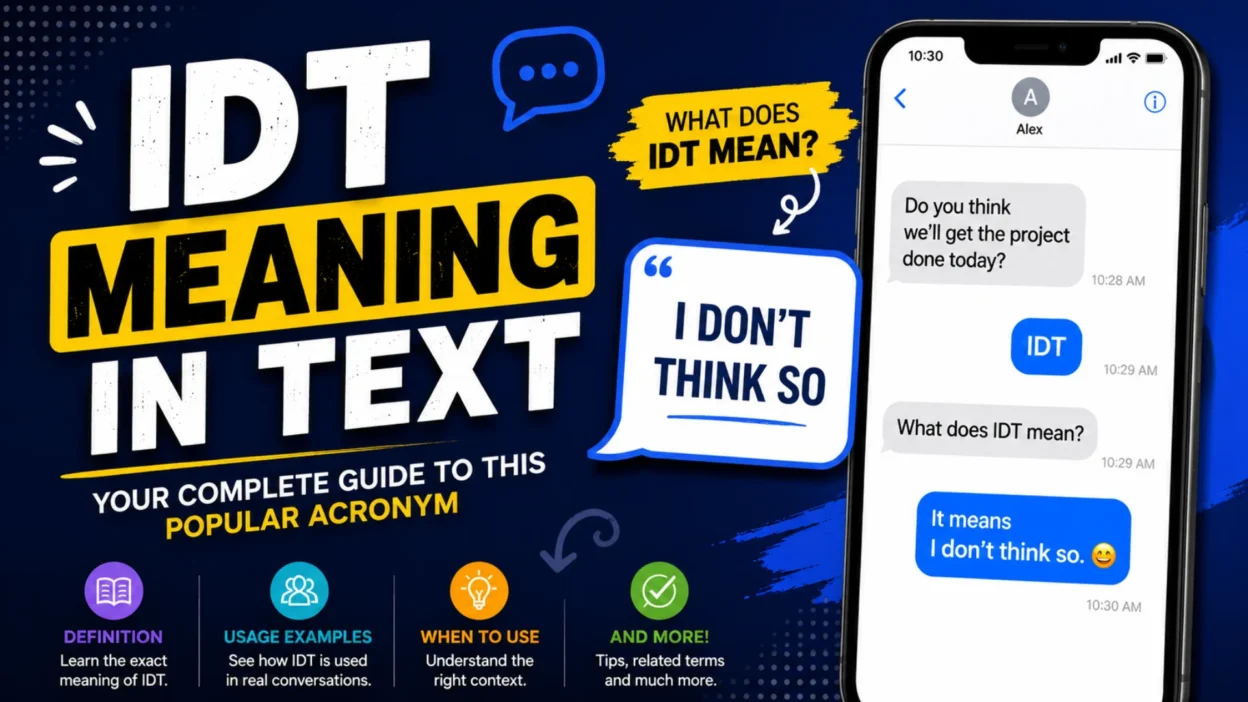
In the fast-paced world of digital communication, idt meaning in text acronyms pop up everywhere. Whether you are scrolling through social media, texting friends, or chatting in online communities, understanding these terms can help you stay in the loop. One acronym you will frequently encounter is IDT. But what does it actually mean, and when should you use it?
This guide breaks down everything you need to know about IDT, from its definition and origins to proper usage and common misconceptions. By the end, you will be able to use this popular slang term confidently and appropriately in your daily conversations.
What Does IDT Mean in Text?
In most casual settings, IDT stands for “I don’t think.” It is a shortened, casual way to express doubt, disagreement, or uncertainty in digital conversations. Think of it as an emotional shortcut. Instead of typing out a full response, you just drop IDT, and everyone instantly gets your tone.
Here is a quick comparison to show where it fits:
| Expression | Emotion | Intensity | Example |
|---|---|---|---|
| IDT | Doubt, disagreement, uncertainty | Low | IDT that is a good idea |
| IDK | Lack of knowledge | Low | IDK what to do |
| IDTS | Strong disagreement | Medium | IDTS that will work |
| I don’t think so | Clear disagreement | High | I don’t think so |
Where Did IDT Come From?
To understand IDT, you need to look back at how internet acronyms evolved. As texting and instant messaging became popular in the early 2000s, people started shortening common phrases for speed and convenience.
Platforms like AOL Instant Messenger, MSN, and later SMS messaging helped spread this term among teens and young adults. It became a go-to response in informal online communication. It was simple and efficient. By the 2010s, IDT was firmly embedded in everyday texting and social media culture.
How to Use IDT in Different Contexts
IDT adapts easily to different settings. Here is how it shows up:
Texting
IDT we are going to make it on time.
Social Media
IDT this is going to work out.
Gaming
IDT that was a fair move.
Casual Conversation
IDT he likes you like that.
In all these examples, IDT conveys quick emotion. However, tone depends on context. Among friends, it is casual and natural. In serious discussions, it can sound thoughtful or uncertain.
Common Misconceptions About IDT
Many people misunderstand IDT. Let us clear up a few myths:
| Misconception | Reality |
|---|---|
| IDT is always rude | Often neutral and depends on context |
| IDT means I don’t know | Actually means I don’t think |
| IDT is fine for work chats | Not suitable for professional settings |
Another myth is that IDT always sounds dismissive. In truth, IDT? can be playful and curious, while IDT! looks firm or certain. Also, while it can occasionally stand for other things like Inactive Duty Training or Integrated Device Technology, in everyday texting it almost always refers to I don’t think.
Alternatives to IDT
If you want to express doubt or disagreement without slang, there are plenty of alternatives:
| Term | Tone | When to Use |
|---|---|---|
| IDT | Casual doubt, informal | Texting, social media |
| I don’t think so | Clear disagreement | General conversations |
| I’m not sure | Uncertainty | Polite discussions |
| Perhaps not | Gentle doubt | Formal settings |
Think of IDT as the quick version. It is efficient and direct. The others are more formal, clear alternatives.
How to Respond When Someone Uses IDT
When someone drops an IDT in conversation, your reply should match their tone.
If they are expressing doubt
Show understanding.
Friend: IDT we are going to finish this on time.
You: Yeah, you might be right. Let us work faster.
If they are disagreeing
Ask for clarification.
Friend: IDT that is the best option.
You: What do you think we should do instead?
If they are uncertain
Offer reassurance.
Friend: IDT I can do this.
You: I believe in you. Give it a try.
Regional and Cultural Differences
IDT is mainly used in English-speaking countries, especially the United States, where people are comfortable with casual texting abbreviations. However, reception varies:
| Region | Popularity | Perceived Tone |
|---|---|---|
| United States | Very common | Casual, natural |
| United Kingdom | Common | Slightly informal |
| Asia | Limited | Rare or misunderstood |
| Non-English countries | Rare | Often confusing |
In essence, IDT expresses a universal feeling of doubt. But how it is received depends heavily on cultural norms and familiarity with English texting slang.
IDT vs. Similar Slang Terms
Comparing IDT with other slang helps you understand its intensity:
| Term | Meaning | Intensity | Use |
|---|---|---|---|
| IDT | I don’t think | Low | Casual chats |
| IDK | I don’t know | Low | Uncertainty |
| IDTS | I don’t think so | Medium | Strong disagreement |
| IMO | In my opinion | Medium | Sharing views |
IDT on Social Media and Messaging Apps
On platforms like WhatsApp, Instagram, and Snapchat, IDT often shows up in casual conversations. For example, IDT we are going to make it works as both doubt and honest opinion.
In dating apps, users sometimes use IDT to express uncertainty about plans or feelings. In gaming chats, players use IDT during strategic discussions or when questioning decisions. Its emotional flexibility keeps it a useful slang term.
Case Study
On a group chat with friends planning a trip, one person said IDT we can afford that hotel. Everyone understood it was a mix of doubt and honest opinion. The group then discussed cheaper alternatives. This proves how IDT helps communicate hesitation without sounding harsh.
When to Avoid Using IDT
Even though IDT is common, it is still an abbreviation that may confuse some people. This makes it risky in mixed or formal groups. Some people might not understand it, especially in cultures less familiar with English texting slang.
Occasionally, IDT can be mistaken for:
- Inactive Duty Training – in military contexts
- Integrated Device Technology – in tech contexts
- Israel Daylight Time – in time zone discussions
To stay safe, avoid using IDT in emails, business chats, or around unfamiliar audiences. Always consider the person and the setting before typing it.
IDT in Professional Settings
IDT does not belong in professional spaces. It is casual and abbreviated, which can make you seem unprofessional or lazy. If you are expressing doubt or disagreement at work, it is better to say something else.
| Situation | Informal Phrase | Professional Alternative |
|---|---|---|
| Doubt | IDT that will work | I am not sure that will work |
| Disagreement | IDT that is right | I respectfully disagree |
| Uncertainty | IDT we can do that | I have some concerns about that |
Using clear, respectful language helps maintain credibility while still expressing doubt politely.
The Origin Story of IDT
The origin of IDT traces back to the early 2000s, when texting became the main way people communicated online. Short forms like LOL, OMG, and BRB started appearing in chatrooms and instant messaging. Among them, IDT emerged as a quick way to express doubt or disagreement.
As mobile phones became widespread, IDT grew popular among younger users for its simplicity. Over time, it spread through forums, social media, and everyday texting. It represented the rise of slang terms used online, where words were shortened for speed and style.
Real-Life Examples of IDT
Here are some natural examples showing how flexible the phrase is:
In Texting
IDT we are going to get off work early today.
On WhatsApp
IDT he is coming to the party.
In Gaming
IDT that was a fair play.
In Casual Conversation
IDT you can finish that in time.
These examples show why IDT is a lasting part of texting lingo and informal online communication today.
Why People Use IDT in Digital Conversations
Using IDT in texting does more than express doubt. It builds connection. When someone types IDT, they are sharing their honest opinion instantly, creating openness and engagement. In digital spaces, expressing doubt helps readers understand the speaker’s perspective, something plain text often lacks. This is why IDT feels so natural and direct in chats.
Psychologists note that abbreviations like IDT act as small emotional markers. They help soften statements, making them feel less confrontational. This emotional shorthand makes informal online communication more polite and personal.
IDT in Memes and Pop Culture
The evolution of IDT in memes shows how online humor shapes language. Memes often pair IDT with funny or absurd images to emphasize doubt or disbelief. You will find captions like IDT this is real under photos that seem unbelievable, giving the meme instant relatability.
In pop culture, IDT appears in tweets, TikToks, and YouTube comments. Influencers drop it in captions to sound casual and relatable. This constant visibility keeps IDT trending, proving it is more than slang. It is a reflection of digital communication trends.
The Future of IDT and Emerging Slang
The future of IDT looks steady as new slang continues to evolve. In 2025, texting abbreviations thrive on speed, so phrases like IDT remain relevant. With visual culture growing, IDT may merge with emojis and GIFs to create hybrid reactions.
As AI chat tools, streaming platforms, and global media expand, abbreviations like IDT will keep adapting. Future online meanings may include new twists or regional versions. But IDT’s core purpose of expressing doubt will stay. It represents the creativity and efficiency that define modern communication.
Frequently Asked Questions
What does IDT mean in texting?
IDT stands for I don’t think. It is a casual way to express doubt, disagreement, or uncertainty in messages.
Is IDT rude to use?
No, IDT is generally neutral and not rude. However, tone depends on context and the relationship between the people chatting.
What is the difference between IDT and IDK?
IDT means I don’t think and expresses doubt or disagreement. IDK means I don’t know and shows lack of information.
Can I use IDT in professional emails?
No, IDT is too casual for professional settings. It is best to use full phrases like I don’t think or I am not sure.
What does IDTS mean?
IDTS stands for I don’t think so. It is a stronger version of IDT used to express clear disagreement.
Does IDT have other meanings?
Yes, in different contexts IDT can mean Inactive Duty Training, Integrated Device Technology, Israel Daylight Time, or Interdisciplinary Team.
Conclusion
IDT in text is a popular way to show doubt, disagreement, or uncertainty in casual chats. People use it in texting, social media, and online conversations to express honest opinions quickly. It helps messages feel more natural and conversational. Younger audiences and online communities use IDT most often. But it can appear in messages from anyone who likes casual and efficient communication. Understanding this acronym makes it easier to read texts and respond naturally.
Knowing IDT also helps avoid confusion in conversations. It is a short and simple way to express doubt without writing long sentences. Using it correctly keeps chats clear and friendly. Always remember it is best for casual settings and not for formal writing.

I am Charles K Baxter, a humor enthusiast passionate about spreading joy and positivity through laughter.